Preparing to Support Someone With Their Medicines
The assessment checks that staff understand how they prepare for a medicines visit or administration round, check the relevant information and reduce avoidable distractions.
Completing medicines training is an important first step. Managers also need clear evidence that staff have understood their training and the key principles of safe medicines support.
AJR MedSafe Academy provides an individual, post-training knowledge and understanding assessment for staff working in domiciliary care, supported living and care homes. Each staff member completes it via a personal link and must score 80% or above.
The assessment gives managers documented evidence that staff have understood their training. It is not a practical medication administration competency assessment or workplace sign-off — confirming that an individual is competent to administer medicines in their role remains the responsibility of the care provider, using its own competency framework.
A member of staff may have completed medicines training but still feel uncertain when faced with situations such as:
These situations require more than remembering information from a course. Staff need to know how to remain calm, follow the correct process, recognise when something is not right and ask for appropriate support.
The knowledge and understanding assessment helps you evidence whether staff have understood safe, person-centred medicines principles from their training.

The assessment checks understanding across the key areas covered in medicines training. Depending on your requirements, questions may cover:
The assessment checks that staff understand how they prepare for a medicines visit or administration round, check the relevant information and reduce avoidable distractions.
The assessment checks whether staff understand the safe, consistent process to follow before supporting or administering medicines.
The assessment checks that staff understand how they use your recording system, document the support provided and respond when information is missing, unclear or unexpected.
Safe medicines support is not only about the task. The assessment checks that staff understand the importance of clear communication, respecting the person’s choices and understand the level of support they have agreed to receive.
The assessment checks that staff understand what to do when a medicine cannot be given, including how to record the situation and when to escalate a concern.
The assessment checks that staff understand how to follow care plans and instructions for “when required” and time-sensitive medicines without making decisions outside their role.
Staff should know when to pause, who to contact and how to report a medicines-related concern, discrepancy, incident or near miss.
Where relevant, the assessment can include understanding of safe storage, transporting medicines, disposal arrangements and handling medicines within the person’s home or care setting.
The knowledge and understanding assessment should not feel like an examination designed to make staff nervous.
Each staff member completes an individual online assessment via a personal email link, with a pass mark of 80%. It checks understanding of the topics covered in their medicines training. The process typically involves:
The assessment focuses on knowledge and understanding. It is not a practical observation of medication administration or a workplace competency sign-off, which remain the responsibility of the care provider.
A post-training knowledge and understanding assessment can help managers:
Most importantly, it helps provide reassurance that staff understand not only what to do, but also when to stop and seek advice.
You may benefit from arranging a knowledge and understanding assessment:
Competency should be treated as an ongoing process rather than a one-off tick-box exercise. Training and this knowledge assessment support your wider medicines competency process, but employers should also have their own arrangements for observing and assessing staff competence in practice.
The knowledge and understanding assessment can support:
The assessment can be tailored around the medicines support your team actually provides.
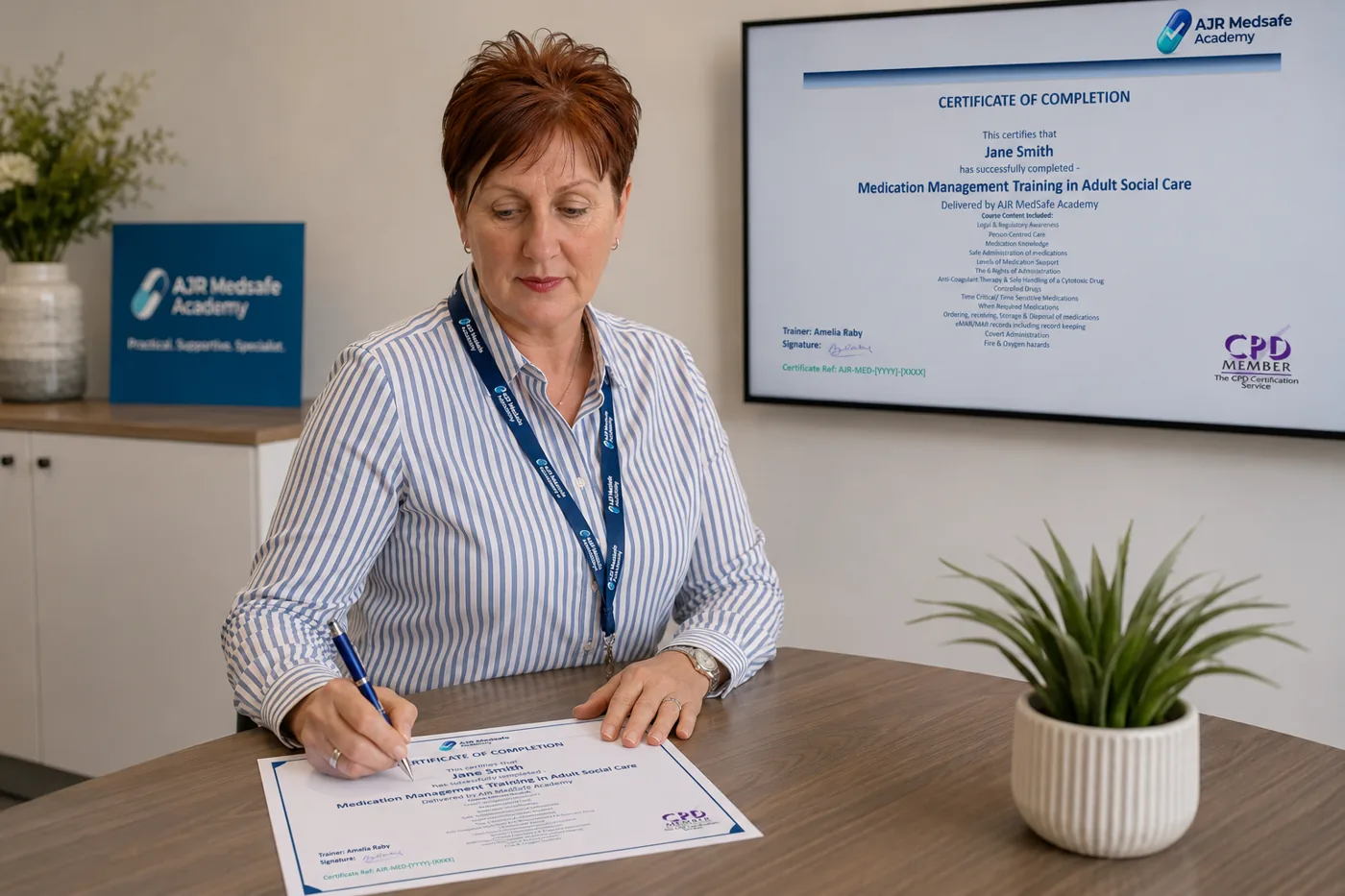
AJR MedSafe Academy is not a generic training company. Training and assessment are led by Amelia Raby, an experienced Pharmacy Technician with more than 22 years of experience across NHS hospital trusts, prison healthcare and community pharmacy.
Amelia has also held leadership roles in service development, quality assurance and medicines management systems. As a former Service Lead for NHS Medicines Support in Norfolk, she delivered medication training to domiciliary care providers across the county.
This experience means your staff receive practical guidance from someone who understands medicines, frontline care and the pressures faced by managers.
You can expect:
Thank you for sending this through. It is not only extremely helpful, but the action plan makes our planning and thoughts so much clearer. We will be in touch again and thanks so much for your support so far. It has been invaluable.Suzanne — Heywoods Grange, Diss, Norfolk
The knowledge and understanding assessment works best alongside training. We provide practical, face-to-face Medicines Management Training followed by the individual assessment — giving you evidence that staff have both been trained and understood it.
View Medicines Management TrainingSometimes staff assessment highlights wider concerns involving policies, care plans, MAR records, governance or organisational processes. Our Pre-CQC Medicines Compliance Audits offer a broader review of medicines systems with practical recommendations.
Explore Pre-CQC Medicines Compliance AuditsNo. Training helps staff develop knowledge and understanding. AJR MedSafe Academy provides a knowledge and understanding assessment that evidences staff have understood their training. A practical workplace competency assessment, which observes staff applying learning in their role, is a separate process carried out by the care provider.
Training is an essential part of staff development, but providers should also have a process for assessing whether staff can carry out the medicines tasks required in their role.
NICE guidance recommends an annual review of the knowledge, skills and competency of staff who provide medicines support. An earlier review may also be appropriate following an incident, a concern or a change in responsibilities.
Yes. The assessment can be shaped around your service, staff roles, MAR or eMAR system, policies and the type of medicines support your team provides.
Yes. AJR MedSafe Academy specialises in medicines support for domiciliary care and also works with supported living services and care homes.
AJR MedSafe Academy provides face-to-face services to care organisations across the UK. Contact us to discuss your location and requirements.
Yes. A supportive reassessment can help identify learning needs, reinforce safe practice and provide managers with a clearer understanding of where additional support may be required.
No single training course or assessment can guarantee compliance. A knowledge and understanding assessment can, however, help strengthen staff development, oversight and the evidence available within your service.
Give your team an individual, post-training assessment that evidences they have understood their medicines training. Contact Amelia to discuss your staff, your service and the knowledge and understanding assessment.
Amelia Raby — Director, AJR MedSafe Academy
07386 357812 ·
info@ajrmedsafeacademy.com