 Amelia Raby
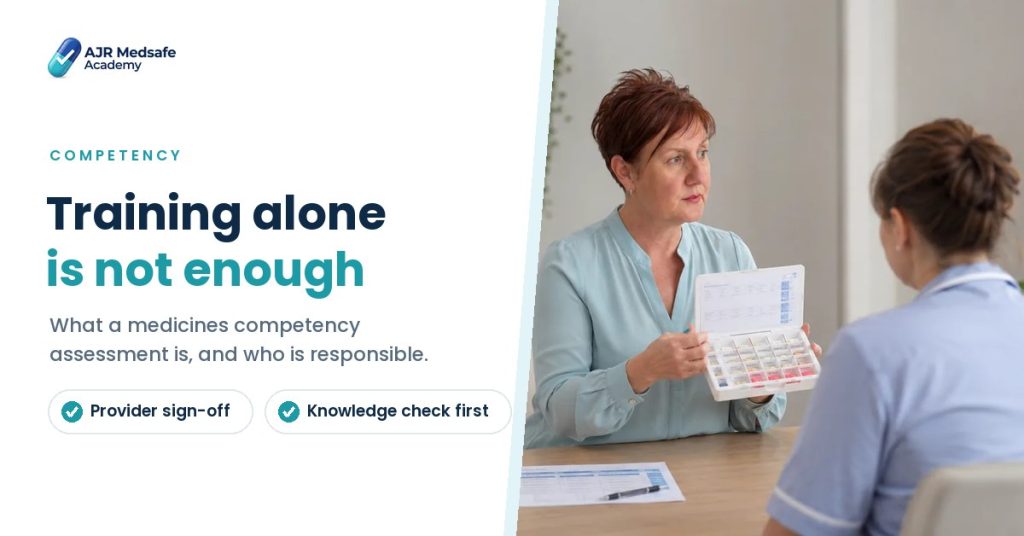
A training certificate shows that a care worker has completed medicines training. It doesn’t show that they are competent to give medicines safely in your service. That’s the job of a medicines competency assessment, and it is the care provider’s responsibility.
At a glance
- A medicines competency assessment confirms that a staff member can give medicines safely in their role, in your setting
- NICE says providers must make sure staff give medicines only once they are trained and assessed as competent, with an annual review
- The care provider carries out the assessment and signs off who may give medicines. It usually includes direct observation
- Training and an individual knowledge check come first, so the assessor has solid understanding to build on
What is a medicines competency assessment?
A medicines competency assessment is the care provider’s structured check that a staff member can apply safe medicines practice in their role. It usually combines direct observation of the person giving medicines with questioning, discussion and a review of their records. NICE’s guideline on medicines support in the community (NG67) specifically includes assessment through direct observation.
A good assessment reflects the role and the care setting, and typically checks whether staff can:
- carry out the right person, medicine, dose, time and route checks
- work within the person’s care plan and level of medicines support
- record administration accurately on the MAR or eMAR
- respond correctly when a medicine is refused, missed or late
- follow PRN (“when required”) instructions and record the reason and outcome
- recognise time-critical medicines
- report stock concerns and escalate unclear instructions
- respond to a medication error, and know the limits of their role and when to ask for help
The purpose isn’t to catch staff out. It’s to confirm safe practice and to identify confidence, gaps and learning needs.
Who is responsible for medicines competency?
NICE’s guideline on managing medicines in care homes (SC1) says providers must make sure designated staff give medicines only when they have had the necessary training and are assessed as competent. Staff who don’t have the skills, even after completing training, must not be allowed to give medicines. SC1 also recommends an annual review of each staff member’s knowledge, skills and competencies, and more frequent review after a medicines-related safety incident.
NG67 sets the same expectations for care workers supporting people in their own homes, including assessment through direct observation and an annual review. CQC’s Regulation 12 requires providers to make sure staff have the qualifications, competence, skills and experience to keep people safe.
The provider carries out, or arranges, the competency assessment and decides who may give medicines. A training certificate can’t make that decision for you.
Training, knowledge assessment and competency assessment
The three are connected, but they are not the same:
Stage 1
Training
Teaches or refreshes the knowledge staff need for safe medicines practice. It’s useful for induction and regular refreshers.
Internal or external
Stage 2
Knowledge assessment
An individual check that each person has understood the training, which shows where more support is needed.
Internal or external
Stage 3
Competency assessment
Confirms the person can give medicines safely in your setting, usually by observation, questioning and record review.
The provider’s responsibility
AJR MedSafe Academy supports the first two stages. Our Medication Knowledge & Understanding Assessment is an individual check after training, completed online through a personal link with an 80% pass mark. It gives managers clear evidence of each person’s understanding and shows who may need more support before they are observed. Practical, observed workplace competency assessment and sign-off remain the responsibility of the care provider.
Many providers pair it with medicines management training for care providers, so that learning and evidence of understanding are in place before their own competency assessment.
Individual Knowledge & Understanding Assessments
Online, personal-link assessment after training, with an 80% pass mark.
When should medicines competency be assessed?
Providers commonly assess or reassess medicines competency:
- before a staff member gives medicines independently
- at least annually, as NICE recommends
- after a medication error or near miss
- when a staff member changes role, or returns after a long absence
- when introducing a new MAR or eMAR system
- when managers spot repeated recording concerns
The frequency should reflect your policy, the staff member’s role, the level of medicines risk and any concerns identified. If an assessment identifies gaps, record the actions taken, such as further training, supervision, shadowing or reassessment.
Competency records and CQC evidence
Clear records show that medicines training isn’t a tick-box exercise. Strong evidence usually includes:
Knowledge
Training records and the results of an individual knowledge check for each staff member.
Observation
A record of the observed assessment: what was observed, when, and the questions asked.
Sign-off
A dated sign-off by a named assessor, and what happens if someone isn’t yet competent.
Review
Reassessment dates, and actions taken after incidents or when gaps were identified.
If your service is preparing for inspection, it may also help to review your wider medicines evidence through a Pre-CQC medicines compliance audit.
Expert insight from Amelia Raby
Amelia often sees providers with training certificates on file but little evidence of how competence was confirmed. A short individual knowledge check after training shows where understanding is weak, so the provider’s own observed assessment can focus on what matters most for each person.
How AJR MedSafe Academy can help
AJR MedSafe Academy is led by Amelia Raby, a GPhC-registered Pharmacy Technician with more than 22 years of medicines experience. We can help with:
- CPD-certified medicines management training
- individual Medication Knowledge & Understanding Assessments after training
- training and knowledge assessment packages
- Pre-CQC medicines compliance audits
We don’t carry out practical, observed workplace competency sign-off. That stays with your organisation, using your own competency framework.
You can view medicines management training pricing or book medicines management training and knowledge assessments.
Frequently asked questions
What is a medicines competency assessment?
It is the care provider’s structured check that a staff member can give medicines safely in their role, usually including direct observation, questioning and a review of their records. AJR MedSafe Academy provides an individual Knowledge & Understanding Assessment after training (online, personal link, 80% pass mark). Practical, observed workplace competency assessment and sign-off remain the responsibility of the care provider.
How often should medicines competency be reassessed?
NICE recommends an annual review of staff knowledge, skills and competencies for managing and administering medicines, with more frequent review after a medicines-related safety incident. Many providers also reassess after role changes, long absences or performance concerns.
Is medicines training enough on its own?
No. NICE says staff should give medicines only once they are trained and assessed as competent. Training and a knowledge check show that learning has taken place. The provider’s competency assessment confirms safe practice in the workplace.
Can AJR MedSafe Academy sign off my staff as competent?
No. Our Knowledge & Understanding Assessment checks each person’s understanding of the training. Confirming competence, and deciding who may give medicines, is your organisation’s responsibility, using your own competency framework.
Can competency records support CQC readiness?
Yes. Knowledge check results, observed assessments, dated sign-offs and reassessment records can support staff files, supervision, medicines governance and inspection preparation.
Useful guidance for care providers
- NICE guideline SC1, Managing medicines in care homes: recommendations 1.17.1 and 1.17.5
- NICE guideline NG67, Managing medicines for adults receiving social care in the community: recommendation 1.11.1
- CQC, Training and competence in medicines optimisation in adult social care
- CQC, Regulation 12: Safe care and treatment
- Skills for Care, Medicines management resources
This article is for general information only. Competency records can help strengthen staff evidence and medicines governance, but they can’t guarantee CQC compliance, a rating or an inspection outcome. AJR MedSafe Academy is independent and not affiliated with the Care Quality Commission.